TL;DR
The OpenAI-compatible API schema won. It is the SMTP of AI: the wire protocol every SDK, agent framework, and orchestration tool speaks in 2026. But the runtime underneath it was never built for production AI inference at scale. Reserved inference fixes the runtime without touching the protocol.
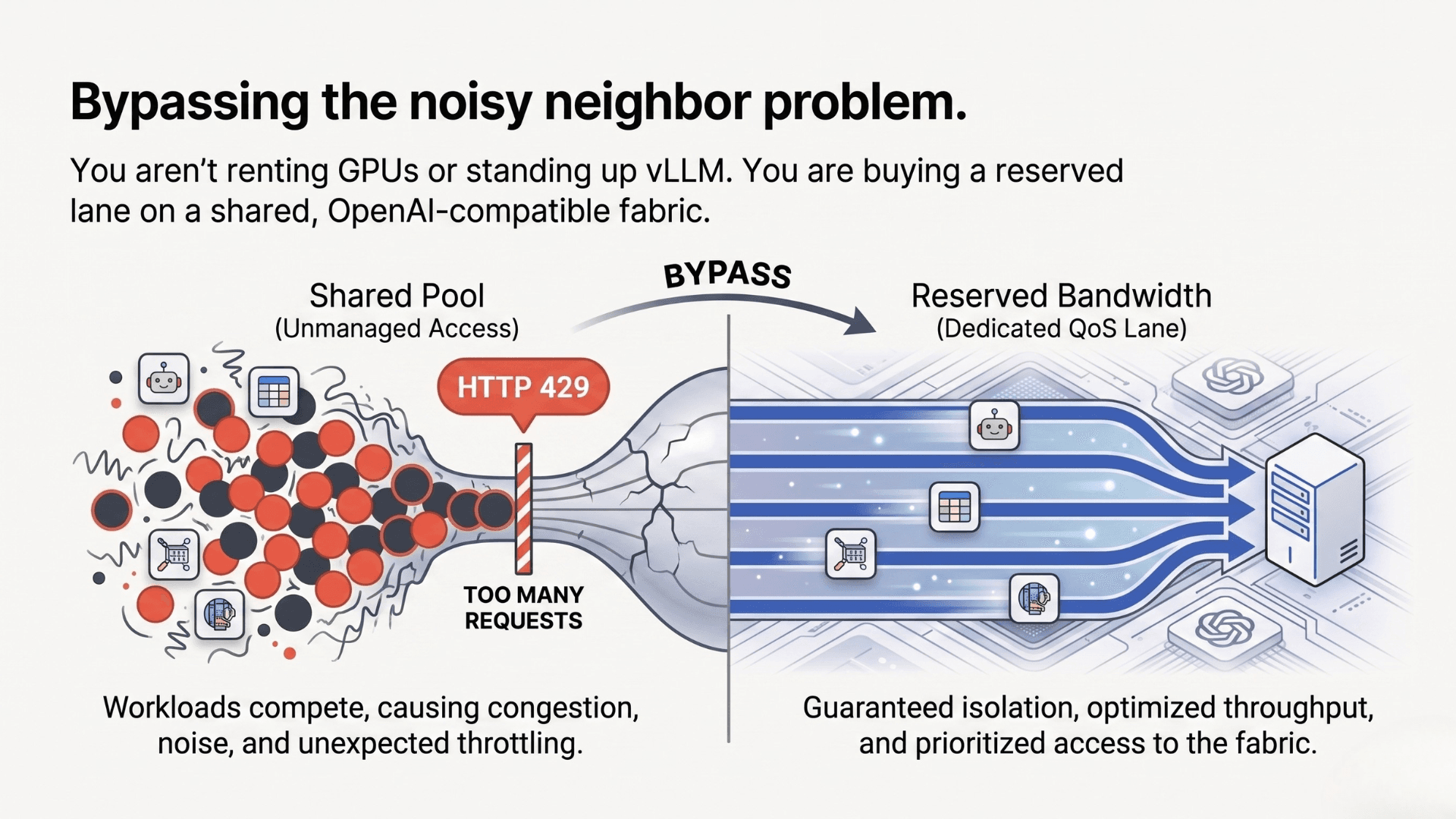
OpenAI-compatible reserved inference means dedicated GPU capacity served behind the standard OpenAI /v1 REST schema with deterministic latency SLOs. The migration cost is intentionally small: change the base_url, update the API key, and keep the rest of the workflow intact.
- Definition: dedicated GPU inference capacity exposed through the standard OpenAI /v1 REST schema.
- Architecture: fair-share scheduling, prefix-aware KV-cache reuse, declarative failover routing, and per-tenant observability.
- Performance: prefix-cache reuse can improve TTFT from roughly 10-20% on short chat to 6-8x or more on long-prefix workloads.
- Migration: two lines of code. Existing OpenAI SDKs and tools continue working.
What is OpenAI-compatible reserved inference?
Reserved inference is a deployment model in which a developer's dedicated GPU inference capacity is exposed through the OpenAI v1 REST API, allowing existing OpenAI SDKs and downstream tools to consume single-tenant inference without modification.
It composes two ideas that matured separately and are now ready to combine. First, a reservation runtime: GPU capacity committed to one tenant, scheduled with fair-share algorithms that bound tail latency. Second, a protocol-faithful proxy that speaks the OpenAI Chat Completions schema with enough fidelity that existing clients cannot tell the difference.
Together they solve the structural problem: the AI inference infrastructure layer standardized on a clean wire protocol before anyone built the production runtime to back it.
20M+
Vercel AI SDK monthly downloads in 2026
8.8M
OpenAI Python SDK weekly downloads
170x
Peak TTFT improvement reported for long-prefix workloads
2
Lines of code to migrate from an OpenAI client
How the OpenAI wire protocol became the standard
Walk into any production AI codebase shipped after 2024 and the same pattern appears near the top: a single OpenAI(base_url=...) constructor. This is not a coincidence. It is the outcome of real standardization pressure in the LLM infrastructure ecosystem.
The adoption numbers are unambiguous. The Vercel AI SDK exceeds 20 million monthly downloads. The OpenAI Python SDK sustains 8.8 million weekly downloads. The ecosystem that now consumes the OpenAI compatible API natively includes LangChain, LlamaIndex, Claude Code, Cursor, Continue, Cline, OpenClaw, OpenCode, n8n, Zapier, Make, and Retool.
Anthropic, Google, Mistral, and Groq each publish OpenAI-compatible endpoints in their own official documentation. The OpenAI API alternative ecosystem grew not by competing with the schema but by adopting it. The integration cost of not speaking the OpenAI schema became higher than the cost of supporting it.
The real surface area of protocol compatibility
Most claims of OpenAI compatibility cover only the basic chat completions endpoint and miss the surface area where production AI inference actually lives. A serious compatibility plane covers request schema, response schema, streaming semantics, adjacent endpoints, and behavioral parity.
Streaming tool-call reassembly is the single most common silent failure mode in AI inference infrastructure compatibility layers. Partial deltas that reassemble incorrectly, or out-of-order tool_call_id references, can corrupt downstream agent loops without ever returning an HTTP error.
| Compatibility category | Key elements | Common failure mode |
|---|---|---|
| Full request schema | Role types, tools, tool_choice, response_format, logprobs, seed, reasoning_effort, parallel_tool_calls | Partial tool_choice support |
| Full response schema | Finish reasons, usage splits, system_fingerprint, refusal objects | Missing usage.cached field |
| Streaming semantics | SSE framing, DONE sentinel, partial tool-call deltas, mid-stream errors | Tool-call delta reassembly corruption |
| Adjacent endpoints | /v1/embeddings, /v1/responses, /v1/files, /v1/batches, /v1/moderations, /v1/models | Only /chat/completions implemented |
| Behavioral parity | retry-after headers, error taxonomy, idempotency-key on POST | Non-standard errors break retry logic |
Four architectural building blocks of a reserved inference plane
Modern dedicated AI inference systems converge on four building blocks, each backed by published research or mature infrastructure practice. Together they produce a substrate the shared-endpoint model structurally cannot match for low-latency AI inference at scale.
01
Fair-share scheduling
Deficit Round Robin and related schedulers bound a tenant's worst-case latency by their own arrival distribution, not by a noisy neighbor's batch job.
02
Prefix-aware KV-cache reuse
Long system prompts or conversation prefixes are pinned and reused across requests instead of being prefilled on every call.
03
Declarative failover routing
A YAML or JSON routing manifest defines traffic distribution, saturation thresholds, and shadow-slice mirroring.
04
Per-tenant observability
Per-tenant TTFT p50/p99, cache hit ratio, queue depth, and SLO burn rate are exported through observability systems.
Scheduling, caching, routing, and observability
Reserved capacity is meaningless without a scheduler that enforces it. The state-of-the-art technique for AI inference scalability is Deficit Round Robin and its derivatives, extended for inference by recent research that combines fairness guarantees with prefix locality.
Prefix caching pins the KV-cache state of a long system prompt or conversation history for reuse across requests instead of re-prefilling on every call. This is now standard in production serving stacks, including vLLM automatic prefix caching, SGLang RadixAttention, and LMCache for cross-engine KV transfer.
A reservation should never lock a developer to one model or one region. Modern LLM infrastructure planes express failover as a declarative routing manifest, where fallback behavior is testable code rather than an incident-response artifact discovered mid-outage.
Every enterprise AI infrastructure slice should expose per-tenant, per-region telemetry: TTFT p50 and p99, inter-token latency p99, prefill cache hit ratio, queue depth, and SLO burn rate. Marketing latency is a paragraph. SLO publication is a contract.
Performance envelope: TTFT and cache gains by workload type
Published benchmarks on prefix-aware KV-cache reuse show workload-shaped gains. These are industry-published numbers on the techniques a reserved inference plane applies, not guarantees for every workload, but they define a realistic validation envelope.
| Workload type | TTFT improvement | Cost impact | Source |
|---|---|---|---|
| Short-context multi-turn chat | 10-20% | Moderate reduction in prefill FLOPs | vLLM prefix cache docs |
| Long-prefix RAG retrieval | 6-8x | Significant repeated-context reuse | BentoML and SGLang benchmarks |
| Document-grounded second request | >7x | High full-document prefix reuse | Pure Storage / vLLM |
| Long-prefix agent loops | Up to 170x | Maximum reduction from prefix match plus scheduling | arXiv 2510.09665 and Sheng et al. |
| Cold-start single request | 0% baseline | No caching benefit on first unique prefix | Baseline |
The two-line migration path
The migration from the OpenAI API or any OpenAI API alternative to a dedicated AI inference endpoint is intentionally minimal. If the migration grows beyond two lines, the premise of drop-in compatibility has failed somewhere in the proxy layer.
Everything downstream, including evaluations, tool definitions, structured outputs, streaming UI, retry libraries, and agent loops, continues working without modification. The OpenAI-compatible endpoint at https://api.openbandwidth.live/v1 works with tools that accept a custom base URL.
from openai import OpenAI
client = OpenAI(api_key=os.environ["OPENAI_KEY"])from openai import OpenAI
client = OpenAI(
base_url="https://api.openbandwidth.live/v1",
api_key=os.environ["OPENBANDWIDTH_KEY"],
)Shared API inference vs dedicated GPU inference
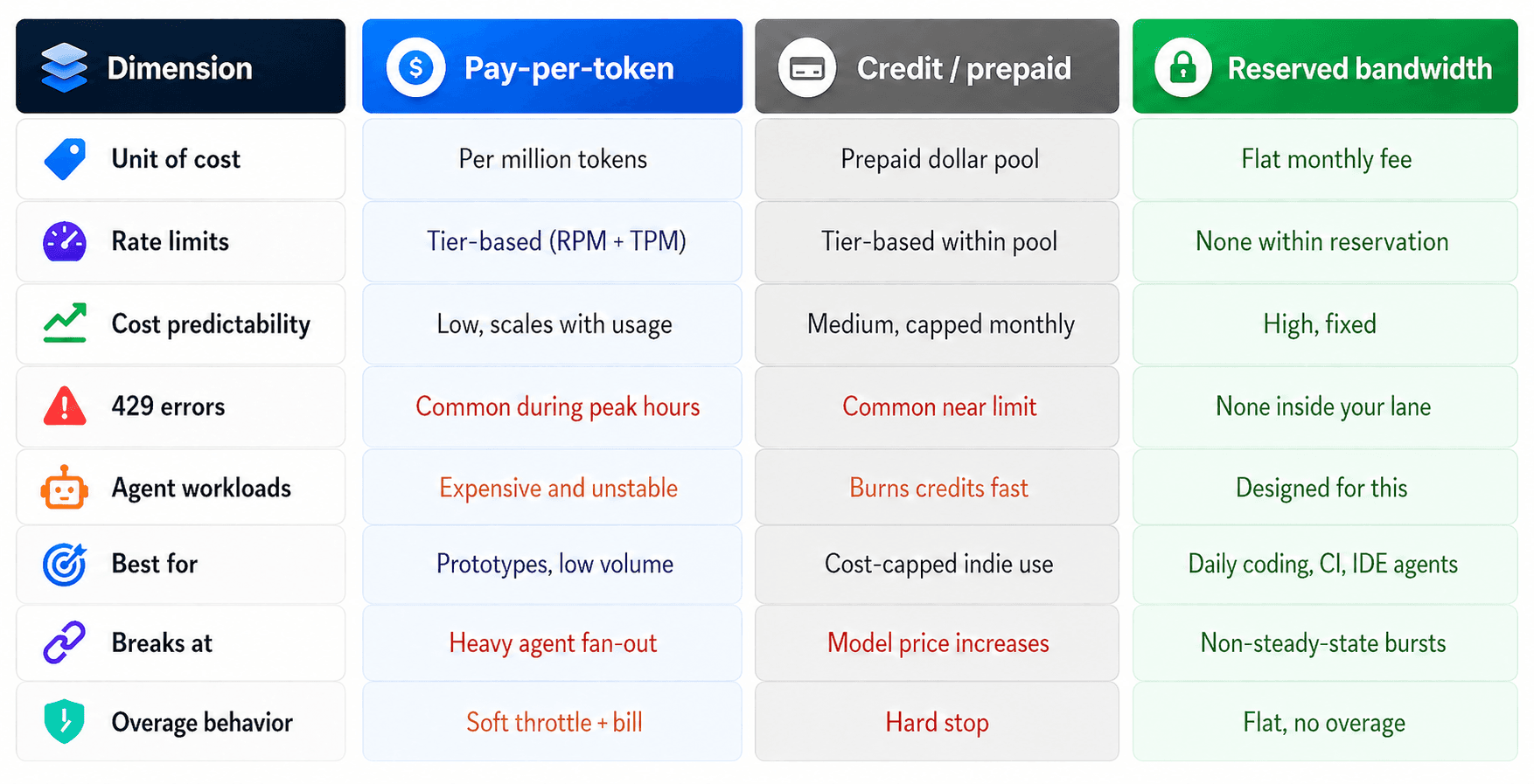
The difference is not only where requests run. It is the operational contract. Shared APIs optimize for pooled utilization and broad access. Dedicated GPU inference optimizes for deterministic latency, tenant isolation, and predictable cost.
| Dimension | Shared LLM API | Dedicated GPU inference |
|---|---|---|
| Latency guarantee | Best-effort and noisy-neighbor affected | Deterministic p99 SLO per tenant |
| Rate limits | Hard TPM/RPM ceilings | Reserved throughput lane |
| Prefix KV-cache | Provider-managed and not per-tenant | Pinned to tenant capacity |
| Cost model | Per token | Flat reservation with unmetered tokens |
| Data retention | Provider policy varies | Zero data retention built in |
| Model lifecycle | Provider-controlled deprecations | Open-weight models and tenant control |
| Observability | Aggregate usage dashboard | Per-tenant TTFT, cache hit ratio, and SLO burn rate |
| Best for | Prototyping and occasional use | Production AI inference and heavy daily use |
Validation path for skeptical engineers
Every architectural claim in this post is empirically testable. Capture representative OpenAI-compatible traffic, replay it against the candidate endpoint, and compare responses field by field. Watch streaming tool-call reassembly and JSON-schema response_format closely.
Measure the prefix-cache effect on your workload by sending the same long system prompt twice and comparing TTFT. Demand per-tenant SLO telemetry before treating reserved capacity as real. If a provider cannot publish p99 latency for your slice in real time, the capacity claim is marketing, not engineering.
Finally, read the scheduler papers. Sheng et al. OSDI 2024 and the 2025 locality-aware fair scheduling paper describe the fairness-versus-locality tradeoff every dedicated inference plane must solve.
FAQ: What is OpenAI-compatible reserved inference?
OpenAI-compatible reserved inference is a deployment model where dedicated GPU capacity is served behind the standard OpenAI /v1 API schema. It combines a reservation runtime committed to one tenant with a protocol-faithful proxy that speaks the OpenAI Chat Completions schema.
FAQ: Why is the OpenAI API the de facto standard for AI inference in 2026?
The Vercel AI SDK exceeds 20 million monthly downloads and the OpenAI Python SDK exceeds 8.8 million weekly downloads as of early 2026. Anthropic, Google, Mistral, Groq, and the broader agent-tool ecosystem adopted the schema because the integration cost of not supporting it became too high.
FAQ: How much does prefix KV-cache reuse improve TTFT?
Published benchmarks show 10-20% improvement on short-context multi-turn chat, 6-8x on long-prefix RAG workloads, over 7x on document-grounded second requests, and up to 170x in scheduling-optimized long-prefix agent loops. Gains are workload-shaped.
FAQ: How do I migrate from the OpenAI API to a reserved inference endpoint?
Set base_url to your reserved inference endpoint, for example https://api.openbandwidth.live/v1, and update your api_key environment variable. All downstream code continues working unchanged if the compatibility layer is faithful.
FAQ: What is fair-share scheduling in LLM serving?
Fair-share scheduling uses Deficit Round Robin and related schedulers to ensure each tenant's worst-case latency is bounded by their own arrival distribution, not by a noisy neighbor's batch job.
Fix your runtime without touching your code
Switch from shared, best-effort inference to dedicated GPU capacity behind the same OpenAI-compatible endpoint your tools already use. Two lines. No SDK changes. No integration sprint.
OpenBandwidth starts at $20/month with flat-rate reserved inference, unmetered tokens inside the lane, and OpenAI-compatible access for developer tools and agent frameworks.