The pricing model is the problem
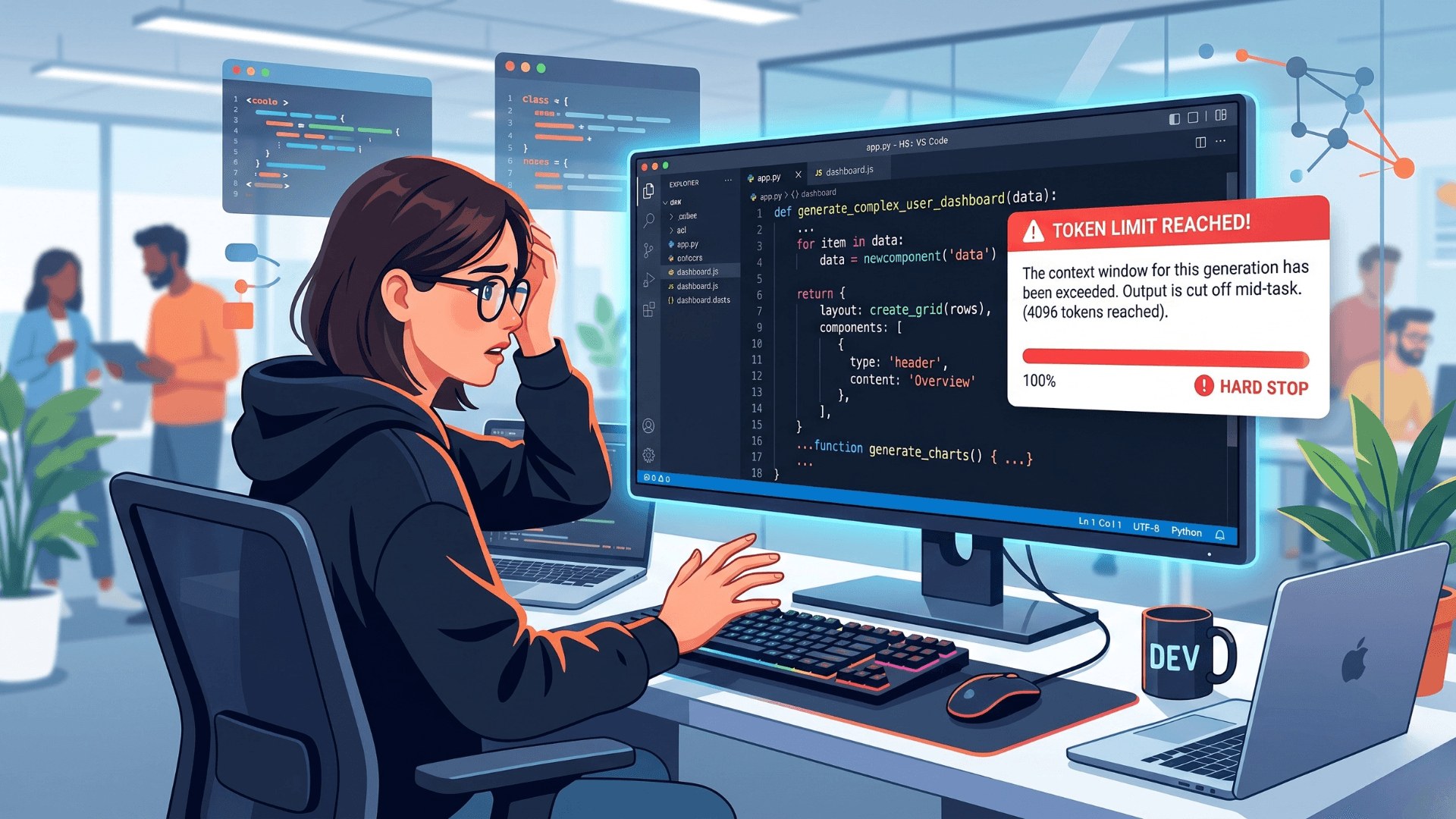
Every developer using an AI coding tool has had the same afternoon. You are deep into a repo-wide refactor, the agent is flowing, tests are passing, and then the red banner appears: rate limit reached, come back later. The work stops, the context evaporates, and the momentum is gone.
This is not just a scaling problem. It is a pricing model problem. Most AI access is still sold like a consumable, one request at a time from a shared pool, which means power users are always one busy hour away from getting throttled.
Reserved AI bandwidth flips that model. Instead of paying like you buy coffee, cup by cup, you buy it like internet access: a throughput tier you pay for once a month and then saturate as hard as your workflow demands.
What reserved AI bandwidth actually means
Reserved AI bandwidth is a pricing and delivery model where you pre-commit to a fixed slice of inference capacity, measured in requests and concurrency, for a flat monthly fee. Inside that reservation, there are no per-token meters, no surprise overage math, and no shared-pool throttle inside your lane.
The closest analogy is broadband internet. You do not pay your ISP per webpage. You pay for a speed tier and then use it as heavily as you need. Reserved AI bandwidth applies the same mental model to inference.
For developers, the practical outcome is simple: your existing OpenAI-compatible workflows keep working, your bill becomes predictable, and long-running coding or agent loops stop dying halfway through the task.
What it is not
Reserved bandwidth gets confused with a few adjacent models, but the differences matter. A prepaid credit pool is still just token billing with a wrapper. An aggregator still inherits upstream provider limits. A private deployment gives you hardware control but adds operational overhead most software teams do not want.
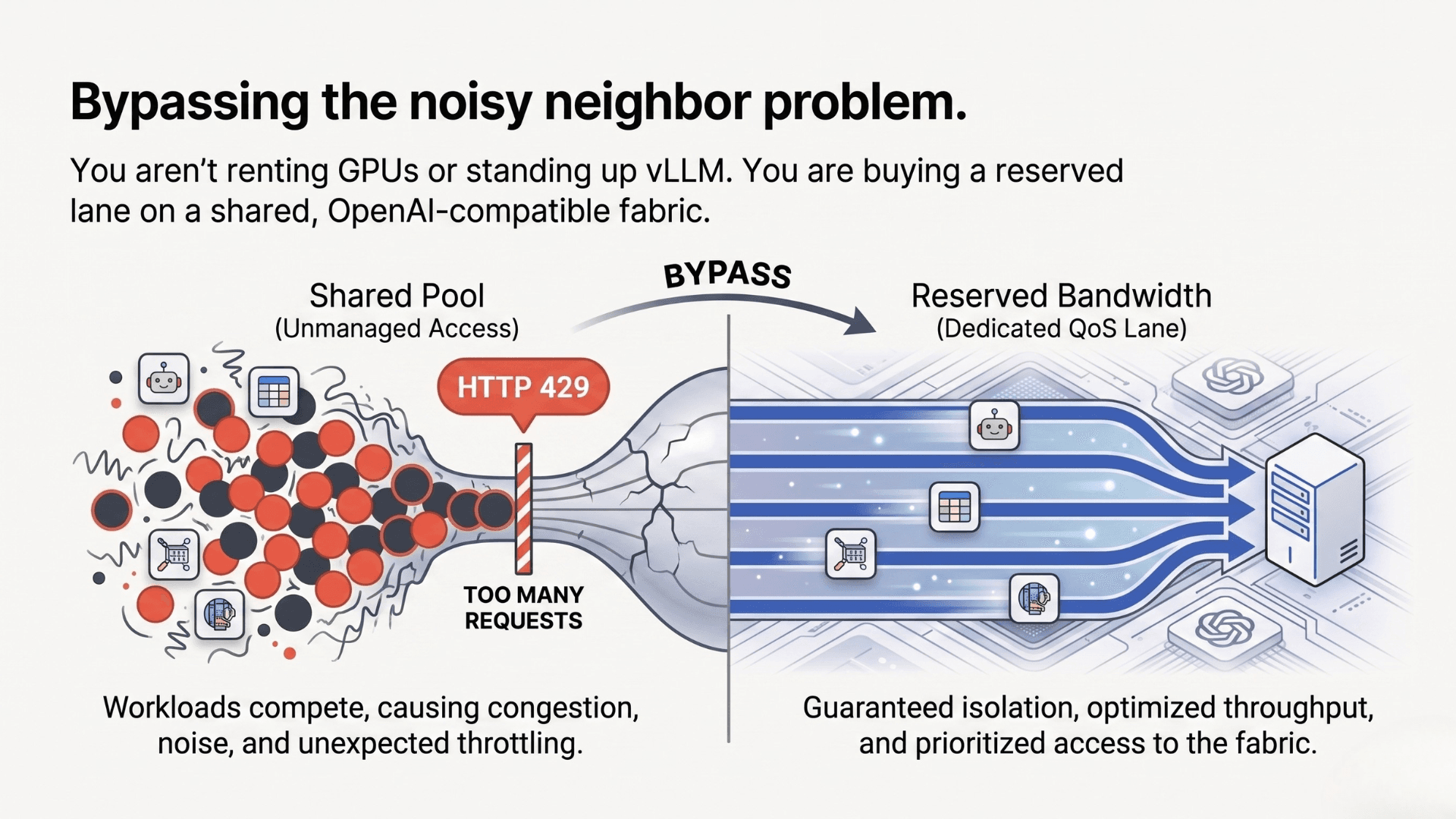
Reserved bandwidth sits in the middle. You are not managing GPUs, autoscaling, or inference servers yourself. You are buying a reserved lane on a shared OpenAI-compatible fabric that keeps the developer experience simple.
- It is not a credit wallet that runs out when usage spikes.
- It is not just request routing across upstream vendors with inherited limits.
- It is not a self-managed GPU stack with vLLM, CUDA, and autoscaling work.
Why token caps quietly break production workflows
Token caps look reasonable on a pricing page because they flatten real workflow complexity into a neat monthly allowance. The problem appears once AI becomes part of real engineering loops. Long context, retries, tool calls, and iterative planning are normal behavior in coding workflows, not exceptional behavior.
When every additional pass eats into a shrinking allowance, developers start working around the pricing model. They trim context they should keep. They avoid running agents on the hardest tasks. They hesitate before asking for another iteration even when another iteration would improve the result.
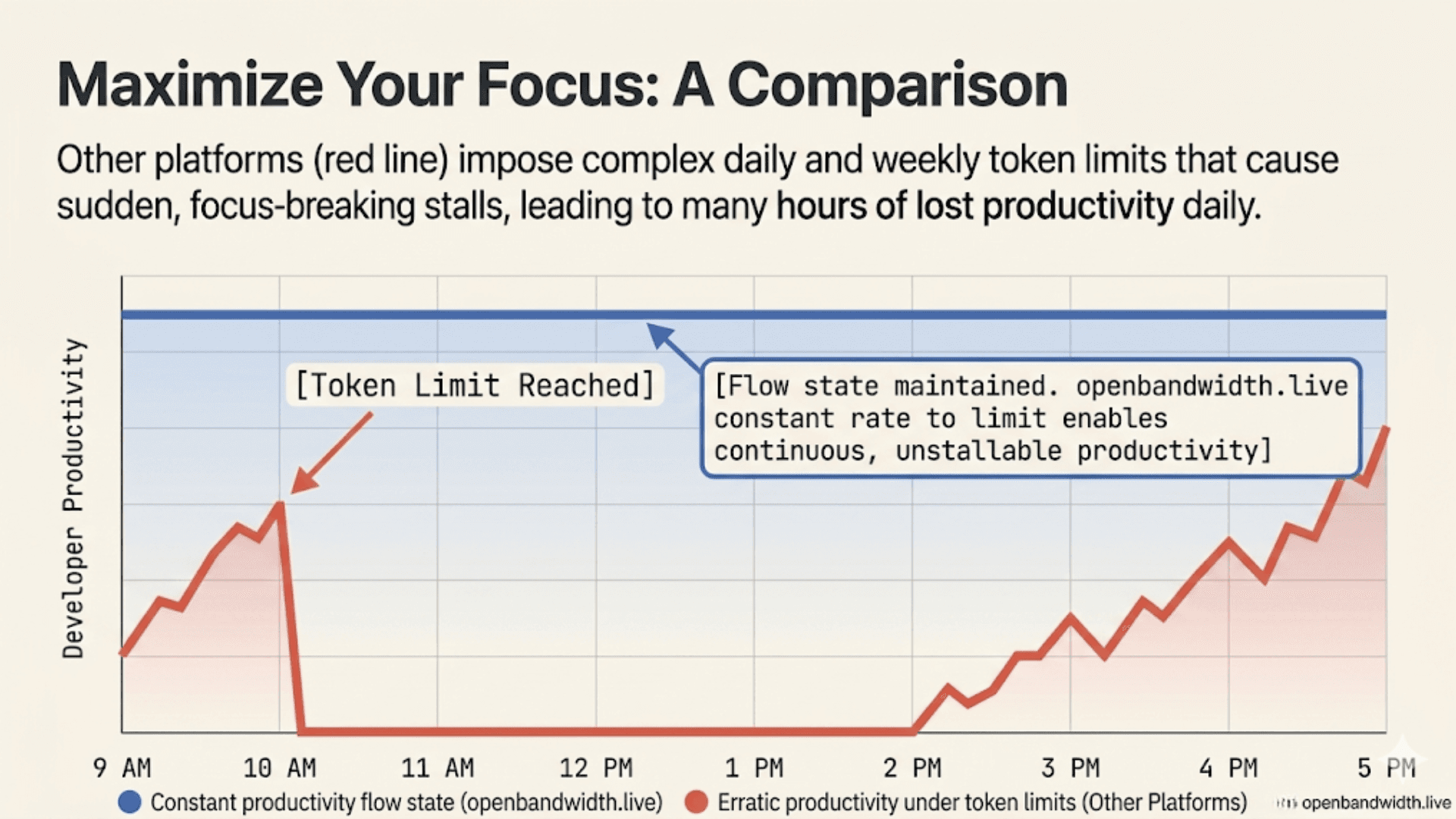
That hesitation is expensive. Teams lose focus when tools stall, waste time rehydrating context after failures, and end up paying a hidden tax in retries and interrupted flow that never appears on the invoice but shows up in lost output every week.
The pattern behind the frustration
Across the market, the same shape keeps repeating. A tool starts with a generous-sounding cap, usage grows, upstream model costs rise, and then the plan changes. Either the allowance shrinks, the price rises, or the user gets squeezed harder during peak hours.
That is why token caps feel fine in prototypes and brutal in production. Shared pools are optimized around averages, not around your most important hour of the day. When usage succeeds, the pricing model gets worse.
- Weekly or monthly quotas get exhausted faster than expected for heavy users.
- Peak-hour traffic turns a premium plan into a waiting room.
- Agentic coding loops consume context and retries much faster than simple chat.
Three pricing models, three very different outcomes
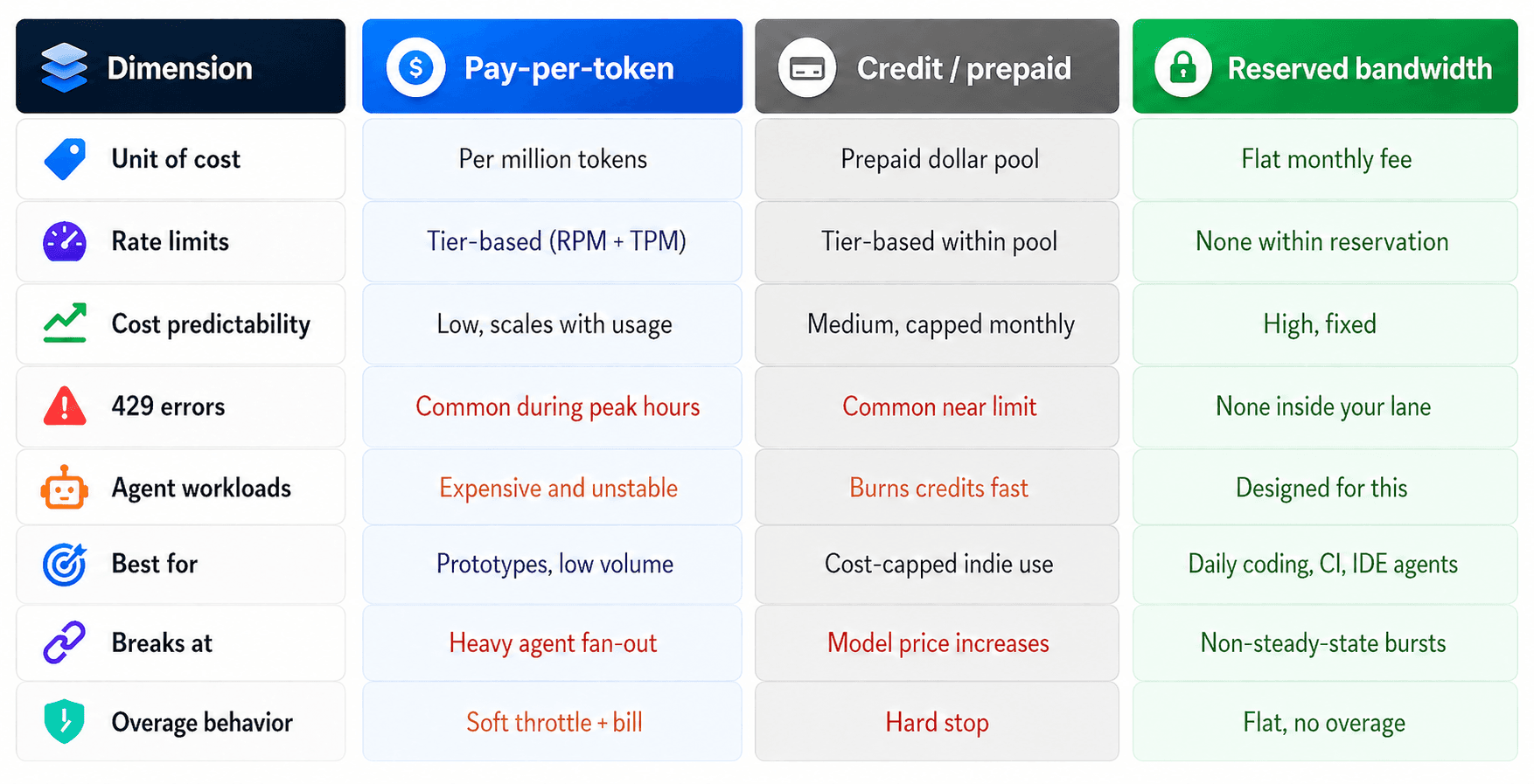
Per-token APIs are great for occasional or experimental usage. Aggregator-style access is useful when you want broad model choice and are comfortable with variable upstream behavior. Reserved bandwidth wins when your team needs AI every day and the cost of interruption is higher than the cost of reserving capacity.
The core decision is not just which model is smartest. It is whether your team needs consumption billing, best-effort access, or guaranteed throughput. Production coding teams almost always care more about the third category than they realize at first.
- Per-token billing: best for sporadic use, research scripts, and low-frequency workloads.
- Aggregator access: best for experimentation across providers, but still exposed to rate-limit variability.
- Reserved bandwidth: best for daily coding agents, CI review loops, autocomplete-heavy IDE use, and long-context work.
When reserved bandwidth beats token billing
The break-even point comes earlier than most teams expect. If AI is part of your daily delivery process, the meaningful comparison is no longer cost per token. It is cost per uninterrupted working day.
Agentic coding loops, multi-file refactors, 24/7 review automation, and autocomplete-heavy workflows all suffer disproportionately from mid-task throttling. In those environments, even a lower nominal monthly price becomes bad value if it causes a hard stop at the exact moment the tool is most useful.
Reserved bandwidth wins by turning that volatility into a flat bill and a guaranteed lane. It is not just about making inference feel cheaper. It is about making it dependable enough to operationalize.
How reserved capacity works under the hood
Architecturally, reserved bandwidth is not a dedicated deployment. You are not renting raw GPUs and standing up your own model servers. Instead, a shared pool of GPU workers runs a curated set of models behind an OpenAI-compatible API, and a scheduler enforces tenant-specific guarantees for requests and concurrency.
That means your request enters your lane, not a first-come, first-served queue that everyone else is fighting over. If the cluster gets busy, your reservation still holds because your committed capacity was carved out before burst traffic from other tenants arrived.
From the application side, this feels close to a dedicated deployment: stable latency, consistent availability, and no constant fear of 429s. The tradeoff is that you use the provider's model library and infrastructure rather than tuning every model server detail yourself.
Why this matters for coding workloads specifically
Coding prompts carry more than chat prompts. They include repository context, proprietary source, tool outputs, and often long planning traces. That makes rate-limit interruptions more expensive and privacy expectations higher.
For that reason, reserved-bandwidth products for code need to deliver two things together: throughput guarantees and zero data retention. If your prompts contain your product, your provider cannot treat them like disposable consumer chat logs.
OpenBandwidth's positioning is built around that combination: OpenAI-compatible access, predictable monthly pricing, reserved throughput, and a zero-data-retention promise for teams using AI on real codebases.
Migration is smaller than most teams expect
One reason teams stay on a bad pricing model is the assumption that switching providers will require a rewrite. In most OpenAI-compatible setups, the migration is much smaller than that. The usual change is a base URL swap, a new API key, and a quick validation pass on the workflows that matter most.
That means most teams can test the new lane with one or two heavy users before rolling it out broadly. If their agent loops, refactors, and IDE workflows improve without code churn, the migration rapidly becomes an infrastructure decision rather than a product rewrite.
- Pick the plan that matches your concurrency and request window needs.
- Store the new API key in your existing secrets manager.
- Update the endpoint configuration used by your SDK, IDE, or internal wrapper.
- Validate generation, tool use, long-context prompts, and retry behavior.
FAQ: What exactly is AI bandwidth?
AI bandwidth is a flat-rate pricing model for inference sized in requests and concurrency rather than tokens. You buy a reserved lane for a fixed monthly fee, and inside that lane there are no per-token charges and no shared-pool rate-limit roulette.
FAQ: How is OpenBandwidth different from Claude Max or Cursor-style plans?
Higher-tier subscriptions still live inside the same general shared-pool logic. You may get a bigger allowance or a higher ceiling, but you are still exposed to allocation changes, peak-hour pressure, and mid-task throttling. OpenBandwidth is positioned around reserving the lane itself rather than simply giving you a larger meter.
FAQ: Does this work with tools I already use?
Yes. If a tool supports a custom base URL and an OpenAI-compatible API surface, the migration is typically minimal. The point is to preserve your existing workflow, prompts, and habits while changing the economic and operational model underneath them.
FAQ: What happens if I approach my plan ceiling?
The idea behind reserved bandwidth is predictable access and predictable cost. Instead of per-token overage math, the right response is usually to move to a higher reservation tier once your team's steady-state concurrency and request patterns outgrow the current lane.
FAQ: When do tokens still make sense?
Per-token billing still works well for true prototyping, one-off scripts, and low-frequency usage. If you touch a model occasionally, metering is fine. Reserved bandwidth becomes the better fit once AI is part of the daily workflow and interruptions start costing more than the reservation itself.
Ready to stop counting tokens?
If your team is hitting rate walls in the middle of work, the real issue may not be the model quality at all. It may be that you are still buying AI with a pricing model designed for occasional prompts instead of production usage.
OpenBandwidth is built for teams that want to buy AI bandwidth, not token anxiety: flat monthly pricing, OpenAI-compatible integration, reserved throughput, and a model that holds up when your workflows get serious.