The shipping wall hidden in AI coding tools
You are mid-session. The architecture is clicking. Your AI coding agent is refactoring a thousand lines of legacy logic and the diff looks clean. Then the wall appears: 429, rate limit exceeded. The work stops exactly when the flow state is strongest.
That moment is not bad luck. In 2026, it is one of the defining friction points of AI-powered development. Teams building serious software with Cursor or Claude Code keep discovering the same thing: the hardest limit is not model quality, it is whether the workflow can stay alive long enough to ship.
What feels like a normal subscription problem on the surface is really an infrastructure mismatch underneath. Agentic coding workloads behave nothing like casual chat, but many plans are still priced and rate-limited as if they do.
The numbers do not lie
By late March 2026, Anthropic had publicly acknowledged that Claude Code users were hitting usage limits far faster than expected, while repeated outages reinforced how fragile these workflows become under real demand.
Heavy users reported exhausting Claude Max 5x in roughly one hour of concentrated work, turning a premium monthly plan into a tool that only supports a fraction of a normal engineering schedule. On the Cursor side, the shift from a simple fast-request model to token-level credit billing made large codebase work dramatically more expensive and much less predictable.
The common pattern is clear. What looks like a simple developer-tool subscription becomes real infrastructure spend as soon as agents, retries, long context, and multi-step tasks become part of the daily workflow.
Why agentic AI breaks metered pricing
The problem is architectural before it is commercial. Traditional chat is close to one message in and one response out, so token counts roughly follow visible text. Coding agents work differently.
A single user action like refactoring a module can trigger a chain of internal model calls for context loading, reasoning, diff generation, testing, and correction. Each step carries prior conversation state forward, so deeper sessions get dramatically heavier over time.
That is why chat-friendly limits collapse so fast in coding workflows. By the time a developer is deep into a real refactor, one request can be carrying a massive context window and consuming budget like an entire sequence of ordinary chat interactions.
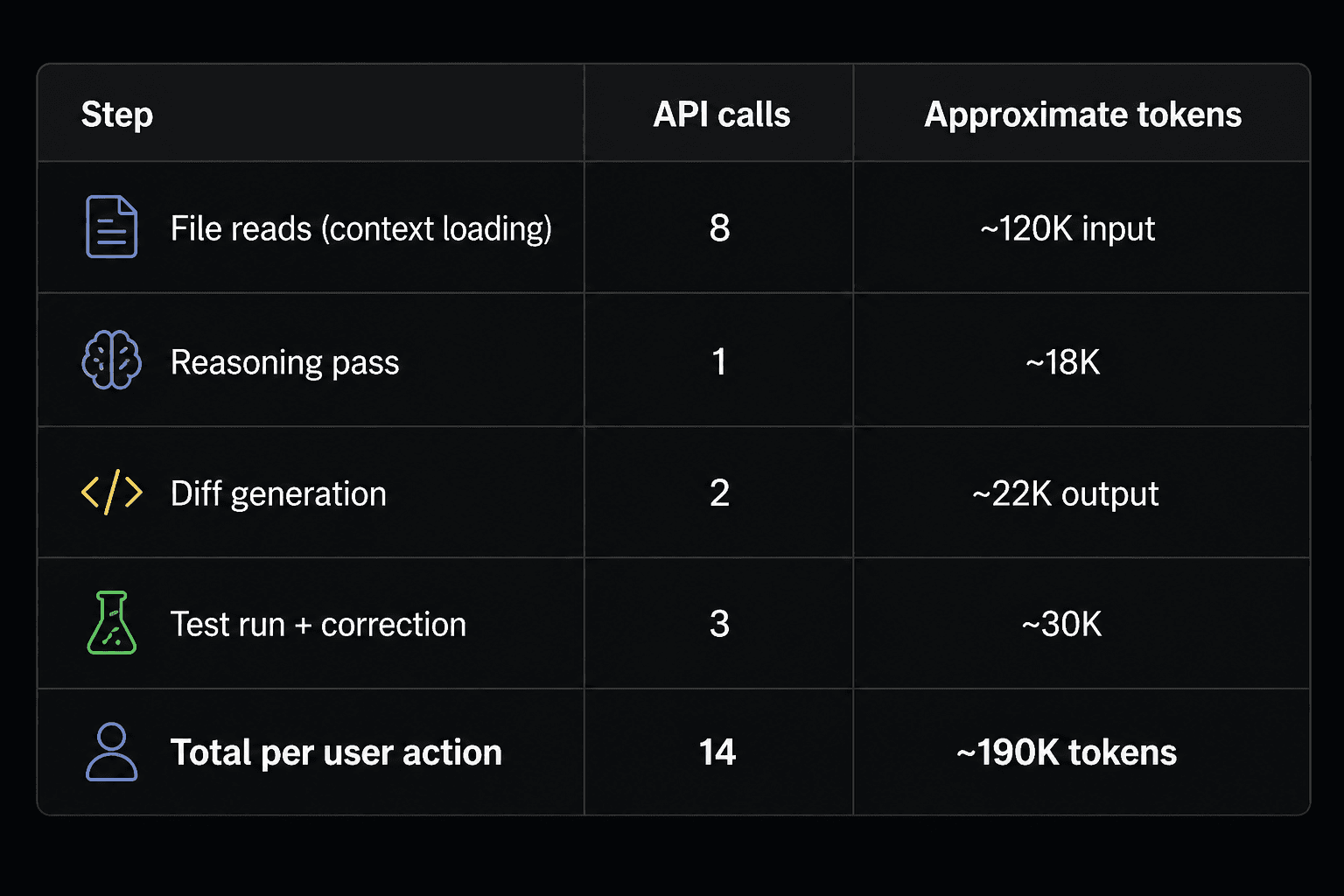
The flow state tax
Every rate-limit hit is more than an interruption. It is a context eviction. The architecture you were untangling, the debugging thread you were following, and the local decisions you were testing do not survive a forced pause cleanly.
Developers do not really resume after a long throttle. They restart. That means the true cost is not the waiting period itself. It is the cognitive reload, the repeated prompting, and the lost momentum that never shows up on the vendor invoice.
This is why upgrading to a higher tier often feels underwhelming. A larger allowance inside the same constrained shared pool just moves the wall later in the day. It does not remove it from the workflow.
What rate limits actually cost a team
The subscription charge is visible. The productivity burn usually is not. When a senior engineer loses a long deep-work block to a mid-session throttle, the output cost can exceed the apparent savings of the cheaper plan very quickly.
Multiply that lost time across several engineers, several days a week, and the silent monthly cost of broken sessions can dwarf the sticker price of the coding tool itself. The damage compounds through sprint planning, review queues, and morale.
This is the hidden tax behind token caps and shared-pool throttling. Teams think they are optimizing software spend, but they are often paying more in interrupted execution than they save on subscription fees.
Why workarounds do not solve the real issue
Teams try many reasonable responses: shorter prompts, smaller files, manual resets, staggered usage windows, or paying for a bigger plan. Those tactics may delay the next failure, but they do not address the design flaw underneath.
The actual problem is not the exact moment a team crosses a limit. The actual problem is that the limit sits inside work the team is already depending on for shipping. Asking developers to schedule their best thinking around quota resets is the wrong optimization target.
As long as the model is metered like a fragile pool instead of delivered like dependable throughput, the workflow remains vulnerable at exactly the moments when it matters most.
A different model: flat throughput with multi-model routing
The alternative is to stop treating serious AI usage like a chat subscription and start treating it like infrastructure. OpenBandwidth is built around flat throughput reservations rather than token metering, with request capacity sized for sustained coding work.
Instead of tying a team to one fragile upstream lane, the platform routes across four frontier-class models: GLM 5.1, Kimi-K2.6, DeepSeek-V4-Pro, and MiniMax-M2.7. If one provider becomes constrained, sessions can continue through the next available lane rather than hard-stopping inside the workflow.
That changes the operating model in practical ways: no token meter on each request, no overage surprise, no mid-session soft throttle inside the reservation, and a predictable monthly cost that infrastructure and finance teams can actually budget.
- No daily token cap resetting in the middle of work.
- No per-minute throttle inside the reserved lane.
- Automatic fallback across four supported models.
- Zero data retention by default for prompts and code.
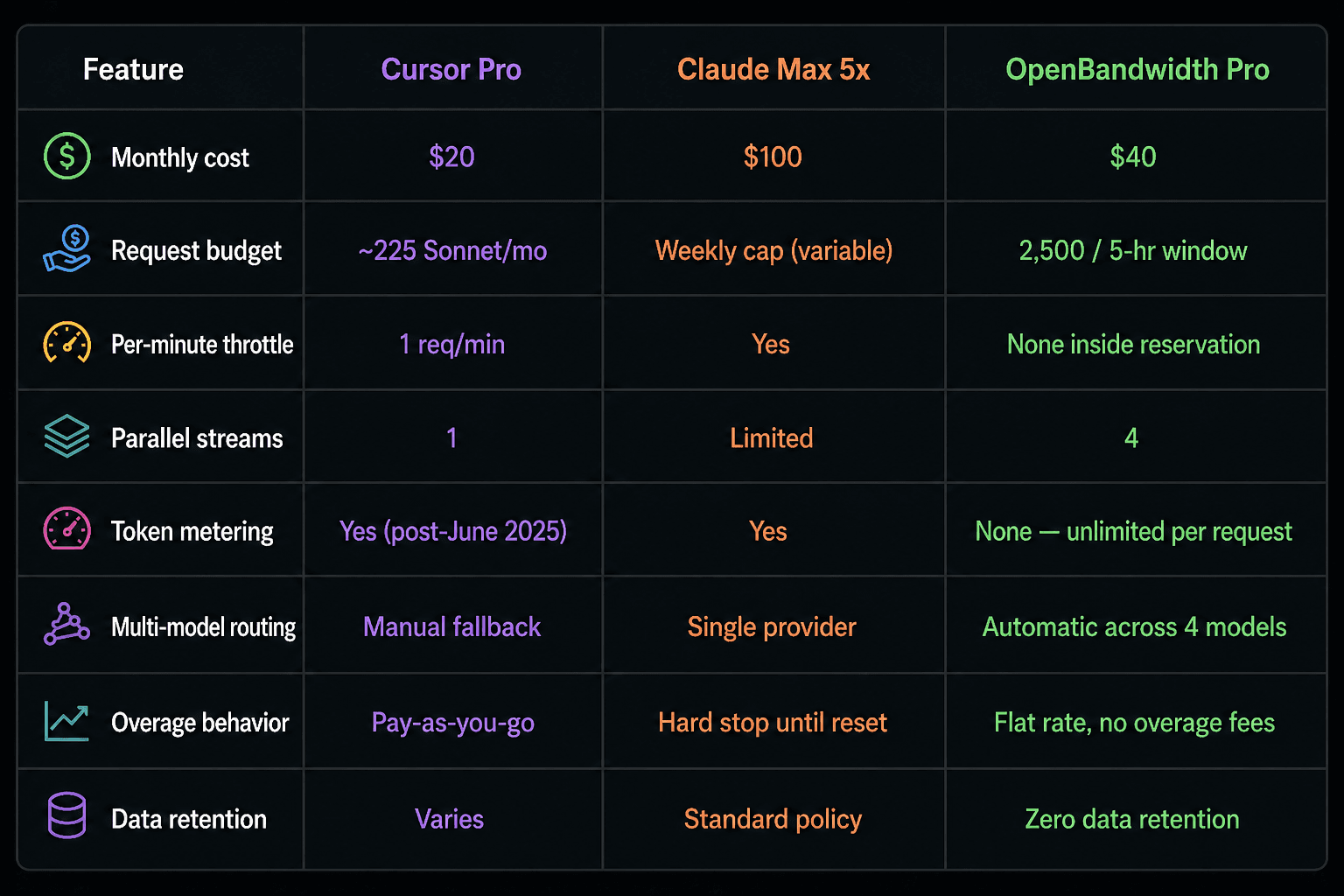
Comparison: Cursor Pro vs Claude Max 5x vs OpenBandwidth Pro
A side-by-side comparison makes the tradeoff clearer. Cursor Pro looks inexpensive until token metering, per-minute throttle, and manual fallback begin shaping the workflow. Claude Max 5x raises the subscription price, but still leaves teams exposed to weekly caps, limited parallelism, and hard stops until reset.
OpenBandwidth Pro is positioned differently. The plan is built around reserved request capacity, parallel streams, flat-rate pricing, and automatic model routing, which means the product is designed for daily coding agents rather than occasional prompt usage.
The bigger picture
Major infrastructure markets tend to move the same way over time: metered access helps the category start, but flat or reserved models unlock the behavior that makes the category indispensable. Broadband beat per-page thinking. Reserved cloud capacity beat pure burst pricing for steady workloads.
AI inference is moving through the same transition now. The teams seeing the most value from coding agents are not using them casually. They are running continuous loops, shipping across large codebases, and relying on iteration speed as a competitive advantage.
That is exactly the behavior token metering punishes. If AI is becoming part of the software delivery stack, it needs to be priced like throughput, not like fragile consumer chat.
Stop scheduling your best thinking around resets
The 429 is not just a Cursor problem or an Anthropic problem. It is the symptom of an industry that sold AI coding access like a SaaS seat when it really behaves like production infrastructure.
If your team is doing real agentic work, the goal should not be to get slightly better at living with resets. The goal should be to remove those resets from the path of shipping entirely.
FAQ: What is a shipping wall?
A shipping wall is any rate limit that interrupts AI work mid-task, whether inside an agent loop, a live pull-request review, or a multi-step refactor. The real cost is not the delay itself. It is the lost context the developer has to rebuild.
FAQ: Why do Claude Code and Cursor hit limits faster than chat tools?
Because a single coding-agent action usually fans out into many internal model calls and carries forward a large running context window. Plans designed around simple chat usage do not hold up under that level of request fan-out.
FAQ: Does paying for a higher tier fully solve the issue?
Usually not. Higher tiers can delay the next limit, but they still live inside the same constrained upstream capacity model. When the shared pool is contested, a bigger allowance does not become guaranteed throughput.
FAQ: Does OpenBandwidth work with Claude Code and Cursor?
Yes. Claude Code can point to a compatible endpoint through `ANTHROPIC_BASE_URL`, and Cursor or other OpenAI-compatible tools can route through `OPENAI_BASE_URL` without rewriting the workflow itself.
FAQ: What happens if a team approaches its reservation ceiling?
The model is designed around predictable flat pricing rather than surprise overage bills. If a team is consistently approaching its reserved lane, the usual next step is moving up to a larger plan instead of getting silently throttled inside the current one.